
There are numerous ventilation systems in the world. Apartments and commercial buildings have largely similar systems but at different scales. This post concentrates on the ventilation systems used in apartments.
A ventilation system consists of all the parts that take part in moving air from the outside of the house, to the inside, and back out again. This should not be mixed with Air Conditioning (AC).
Here you can see schematics of three most commonly used ventilation systems.
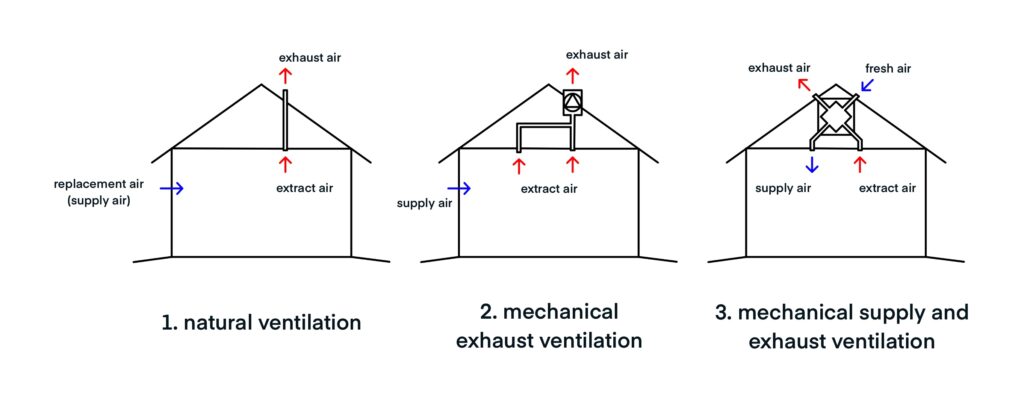
1. Natural ventilation relies on air pressure difference caused by air temperature change. Cold air is denser than warm air. Because of this warm air rises up and cold air falls down. Natural ventilation works well with heated buildings in cold climate, no where else. It’s (near) impossible to control automatically and reliably, and it looses a lot of energy in the form of heat. Natural ventilation also has no filters, so all impurities in the outside air have a direct route to indoors.
2. Mechanical exhaust ventilation was developed to enhance the poorly working natural ventilation. It relies on the exhaust fan to extract air from the building. It works more consistently than natural ventilation but usually loses even more energy. There are heat recovery systems that can be retrofitted to old mechanical exhaust ventilation systems, making it little more energy efficient. Mechanical exhaust ventilation systems also should not have dense filters. Filters would cause a big negative pressure to form in the building.
3. Mechanical supply and exhaust ventilation usually relies on an air handling unit (AHU) to move the air. AHU has two fans, supply and exhaust. It also usually has filters, heat exchanger and a heater. This is the system that gets installed in the new modern buildings (At least in the Nordic countries).
Noteworthy
Systems 1. and 2. rely on the domestic heating system (floor heating, radiators etc.) to heat the incoming fresh air. In system 3. the AHU has a heater dedicated to heating the supply air.