
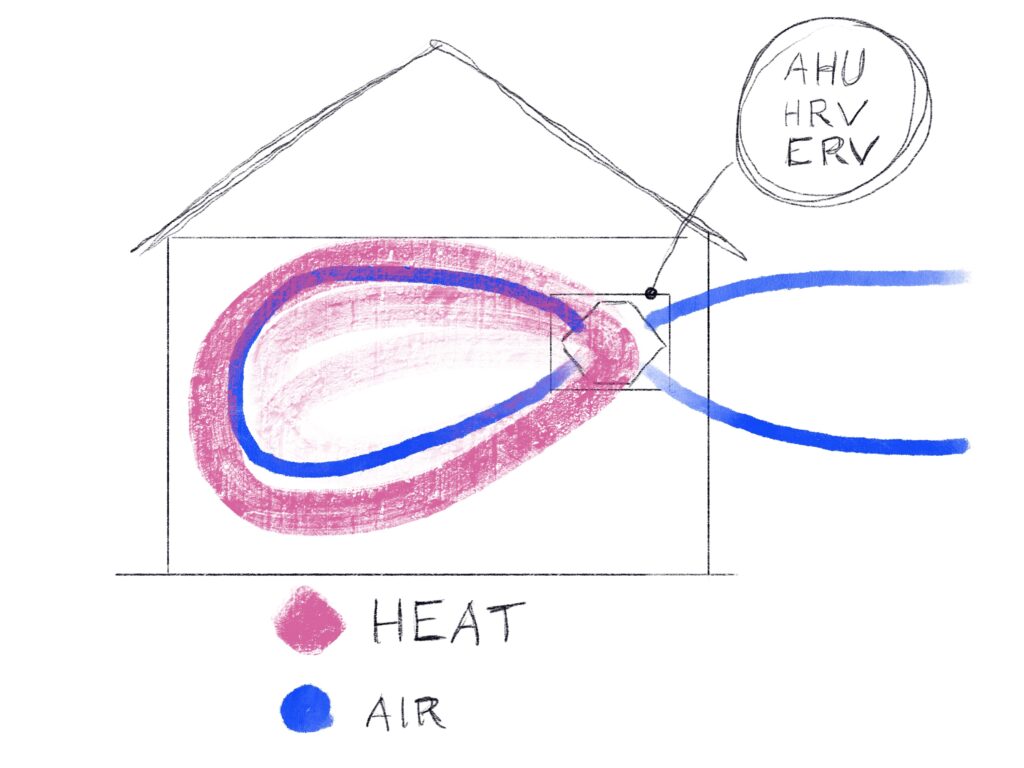
First… An air handling unit (AHU) = Heat recovery ventilator (HRV) / Enthalpy recovery ventilator (ERV)
When we talk about modern building ventilation, one of the unsung heroes is the heat exchanger (heat recovery unit) inside the air handling unit (AHU). Without it, fresh air supply would mean constant energy loss. With it, we can recover a significant portion of the energy already spent on conditioning indoor air, making systems more efficient, sustainable, and comfortable.
The Role of the Heat Exchanger
The purpose of the heat exchanger in an AHU is to transfer thermal energy between the exhaust air (leaving the building) and the supply air (entering the building), without mixing the two airstreams.
- In winter: The outgoing warm exhaust air preheats the incoming cold outdoor air.
- In summer: The cooler exhaust air precools the incoming hot outdoor air.
This energy recovery reduces heating and cooling loads on the building’s HVAC system, directly cutting energy costs and emissions.
Core Principles of Operation
- Heat transfer by conduction and convection
- As warm air passes across a surface, it transfers thermal energy through the exchanger material to the cooler side.
- Counterflow or crossflow geometry
- The efficiency depends on how the two air streams are arranged.
- Counterflow designs (air streams move in opposite directions) maximize temperature difference and heat recovery.
- Crossflow designs (streams cross at 90°) are simpler but usually less efficient.
- Latent heat transfer (if applicable)
- In enthalpy wheels or membrane exchangers, water vapor also migrates between air streams, balancing humidity.
Types of Heat Exchangers in AHUs
Several technologies are commonly used. Each have their characteristics. Rotary heat exchanger can reach the highest temperature recovery efficiency of over 80% while the Coil system has the lowest recovery efficiency.
1. Plate Heat Exchangers (Fixed Core)
- Made of thin plates (metal or polymer) stacked to form alternating channels for supply and exhaust air.
- Available as crossflow or counterflow designs.
2. Rotary Heat Exchangers (Heat Wheels / Enthalpy Wheels)
- A rotating wheel with a large surface area made of aluminum or a coated material.
- As it spins, the wheel alternately absorbs heat from the exhaust air and releases it to the supply air.
- With hygroscopic coatings, they can also transfer moisture.
3. Run-Around Coil Systems
- Two separate coils (one in the exhaust, one in the supply) connected by a closed water/glycol loop.
- Heat is transferred from the exhaust to the fluid and then to the supply.
Why It Matters
With tightening building codes and sustainability goals, energy recovery is no longer optional. Heat exchangers reduce operating costs, decrease CO₂ emissions, and improve thermal comfort. In some cases, they make the difference between a ventilation system being viable or not.
In short: the heat exchanger is the quiet workhorse of modern ventilation—making healthy indoor air possible without wasting energy.
Final Thoughts
An air handling unit’s heat exchanger is a deceptively simple component that embodies modern energy efficiency. By recycling energy that would otherwise be wasted, it helps buildings achieve both comfort and sustainability goals. Whether plate, rotary, or run-around, understanding how these systems work is key to designing, operating, and maintaining effective indoor climates.
Until next time 👋🏻